
Command the Stage.
Inspire the World.


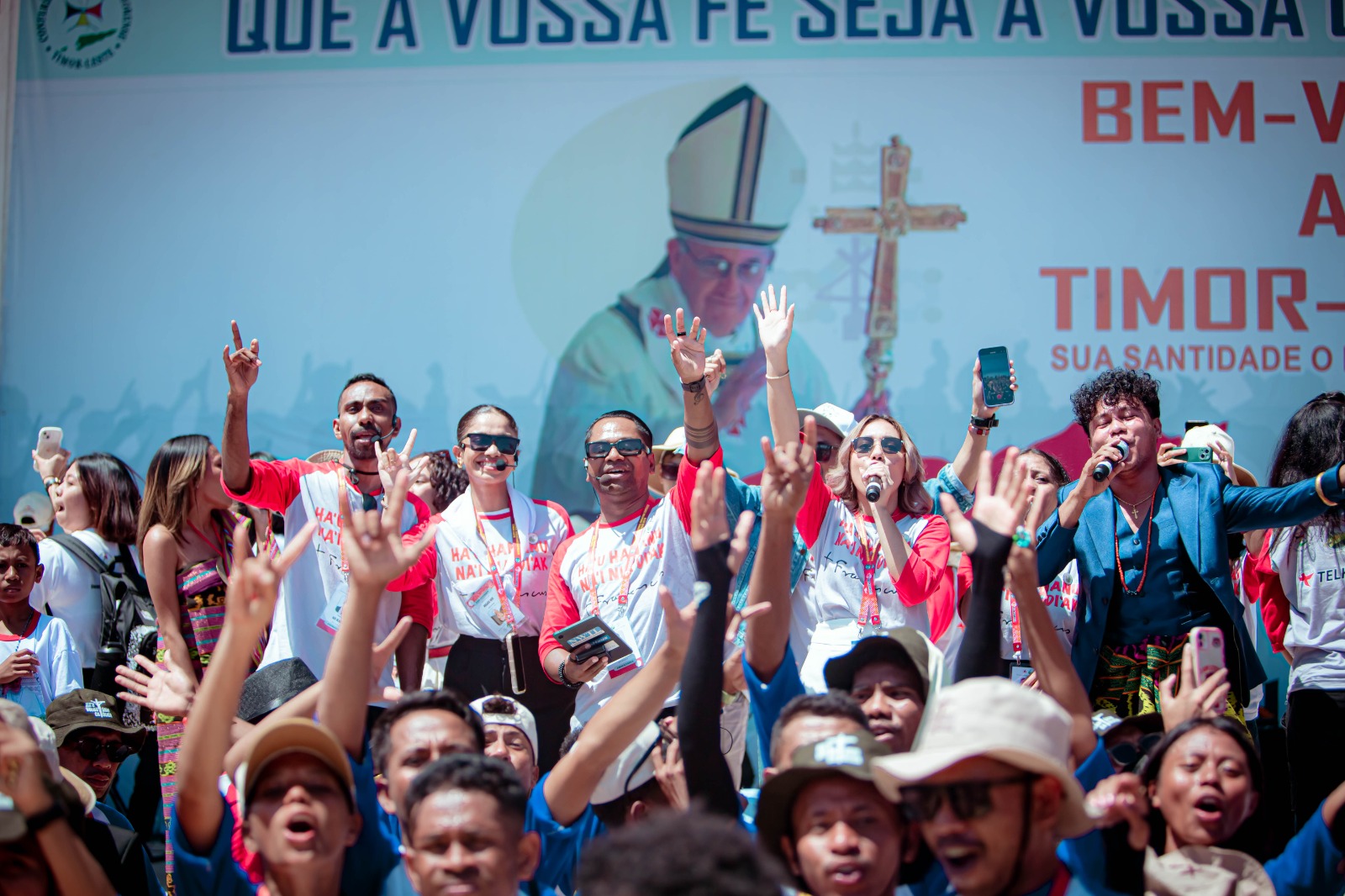
It was September 2024. I was standing backstage at Tasi-Tolu in Dili, the ocean just behind me, and in front of me, a crowd of 600,000 people stretching as far as I could see. The air was electric. The occasion: the Holy Mass of Pope Francis, the first visit of a sitting Pope to Timor-Leste. And I was about to step onto that stage and sing.
People ask me: what do you think about at a moment like that? They expect the answer to be about vocal technique, breathing control, or hitting the right note. But the honest answer is this, I was not thinking about the microphone, or the cameras, or the hundred thousand umbrellas swaying in the heat. I was thinking: this moment is not about me. It is about the people who need to feel something today.
That thought, that shift from performance to service, is the most important lesson I have learned across more than a decade and more than a hundred official ceremonies. And it did not come to me all at once. It arrived slowly, tested event by event, room by room, stage by stage.
When I first started hosting official events, I made the same mistake that many new MCs make. I thought my job was to fill the space, to be present, to be energetic, to be on. I prepared meticulously. I wrote scripts. I rehearsed introductions. I timed every transition. I was technically competent from almost the beginning.
But there is a difference between being technically competent and being truly present. And I learned that difference at a ceremony I will not name, an important state event, formal and high-stakes, where I walked out onto the stage with every word prepared, and within five minutes, I could feel the room disconnecting from me. Not because I made an error. Not because I stumbled. But because I was so focused on executing my plan that I stopped listening to what the room actually needed.
The room needed to breathe. I was filling every silence. The room needed warmth. I was delivering protocol. The room needed a human being. I was delivering a performance.
I finished the event without incident. But I drove home troubled, and I spent a long time thinking about the gap between what I had delivered and what should have been delivered. That discomfort was the beginning of everything I understand today about this work.
Every MC I respect does one thing non-negotiable: they prepare obsessively. For all MC engagements, I hold at minimum two pre-event meetings, the first for the full brief, the second closer to the day for final confirmation. I request the runsheet, the pronunciation guides, the protocol requirements, the context behind every agenda item. I want to know not just what is happening but why it matters to the people in the room.
But here is what I have learned: preparation is the floor you stand on. It is not the performance itself. Its purpose is to free you, to give you such complete knowledge of the territory that on the day, you are not managing information. You are managing energy. You are reading the room. You are present.
“The best MCs I’ve observed and aspired to be, they carry their preparation lightly. They know everything. You can see it in how calm they are. But what the audience experiences is not the preparation. What the audience experiences is the freedom that comes from it.”
⎯ BEPI WHITEHEART
When I stood before the State Meeting with His Holiness Pope Francis at the Presidential Palace, one of the highest-protocol MC assignments I have ever received, I had prepared to the point where the script felt unnecessary. And so I set it down. Not carelessly. Trustingly. The preparation was in my bones. What I brought to the room was something preparation alone cannot give you.
One of the greatest gifts I have received from a decade in ceremonial hosting is learning to love silence. Most new MCs are terrified of it. They hear a pause and they rush to fill it, a transition phrase, a cue, a piece of filler. They treat silence as a problem to be solved.
But silence at an important ceremony is not empty. It is full. It is the space in which people feel what just happened. It is the breath between movements. It is the moment when 600,000 people at Tasi Tolu absorb the fact that the Pope of the Catholic Church is standing in their country, a country that suffered so much to arrive at this moment.
When you interrupt that silence, you are not serving the room. You are serving your own anxiety.
I have learned to ask myself before every transition: does this moment need my voice right now, or does it need more of itself? More often than I expected, the answer is the latter.
Every room is different. The energy of a Presidential Inauguration is not the energy of a gala dinner. The formality required for the ASEAN Accession Ceremony in Kuala Lumpur, where I hosted as Timor-Leste formally became the 11th member of ASEAN, before heads of state from across the region, is not the formality required for a UNDP capacity-building workshop. And neither of those is the energy of the Papal Mass.
An MC who cannot read the room will always be slightly wrong. Too formal for a warm occasion. Too casual for a ceremonial one. Too fast when people need to absorb. Too slow when the energy has already peaked and is ready to move.
Reading the room is not a mystical skill. It is developed attention, attention trained over hundreds of engagements until it becomes instinct. You read body language. You read the silence between announcements. You read whether your opening line landed as warmth or fell as noise. And you adjust, not to your preference, but to what the room is asking for.
My government years trained this in me before I even knew it was a skill. Eleven years in the public service meant eleven years of reading rooms, committees, ministerial briefings, cross-departmental negotiations, diplomatic encounters. The skill transferred. The room is the room, whether it has a throne or a conference table.
This is the principle that took me the longest to understand, and the one I believe most completely today.
At every ceremony I have hosted, the Presidential Inaugurations, the independence day celebrations, the ASEAN accession, the Papal Mass, the 20th of May commemorations year after year, the event is not about me. Not even slightly. My role is to make the people who matter feel seen, honored, and elevated. My role is to make the President feel the weight and the dignity of the occasion. To make the members of the audience feel they are part of something historic. To make the performers feel their contribution is valued. To make the foreign dignitaries feel welcomed.
When an MC makes the event about their own performance, they betray the ceremony. When they disappear into the service of it, when the event is so well run that nobody notices the MC separately, just feels that everything flowed perfectly, that is the highest compliment this work can receive.
“You must know how to do it first, before asking people to follow.”
⎯ BEPI WHITEHEART
I write this not just for MCs, but for anyone who needs to lead from the front. A facilitator running a two-day leadership retreat. A manager presenting quarterly results to their board. A teacher holding the attention of a classroom. A founder pitching to investors. A parent trying to have a difficult conversation.
In every one of these situations, the principles hold: prepare so well that you can be present. Let silence do its work. Read the room before you speak. And remember that your role is always to serve the people you are with, not to impress them, not to perform for them, but to genuinely serve what they need from this moment.
These are the lessons that more than a hundred ceremonies have given me. I did not read them in a book. I learned them in rooms that demanded everything I had, and gave back more wisdom than I arrived with.
And I am still learning. Every room teaches something new.
One last thing, because I am often asked about this. I MC in English, Tetum, and Portuguese. And I have found that the language itself is only a small part of what crosses the distance between a stage and an audience. What truly crosses that distance is the energy behind the words. The genuine commitment to the occasion. The feeling, which audiences sense immediately, that the person at the microphone is truly, completely, unconditionally in service of this moment.
That feeling has no language. It is communicated in every other way that human beings communicate, posture, pace, breath, presence, silence, and the warmth behind the eyes when you look out at 600,000 people and think: I am here because I love this. And I love this room.
If you are working on your own presence as a host, facilitator, or leader, I hope something here has been useful. And if you ever need someone in your room who has learned these lessons the long way, you know where to find me.